Learn Pawn Movement and Chess Piece Roles from Scratch
Published

When you start playing chess, the foot soldiers lined up in the greatest numbers are the pawns. While a chess pawn may seem modest, it forms the backbone of your formation and plays a vital role in directing the course of the game.
Because pawns move forward differently from how they capture enemy pieces, they can confuse beginners. Let us review their core moves step by step.
Moving Forward and Diagonal Captures: How Pawns Advance and Take Pieces
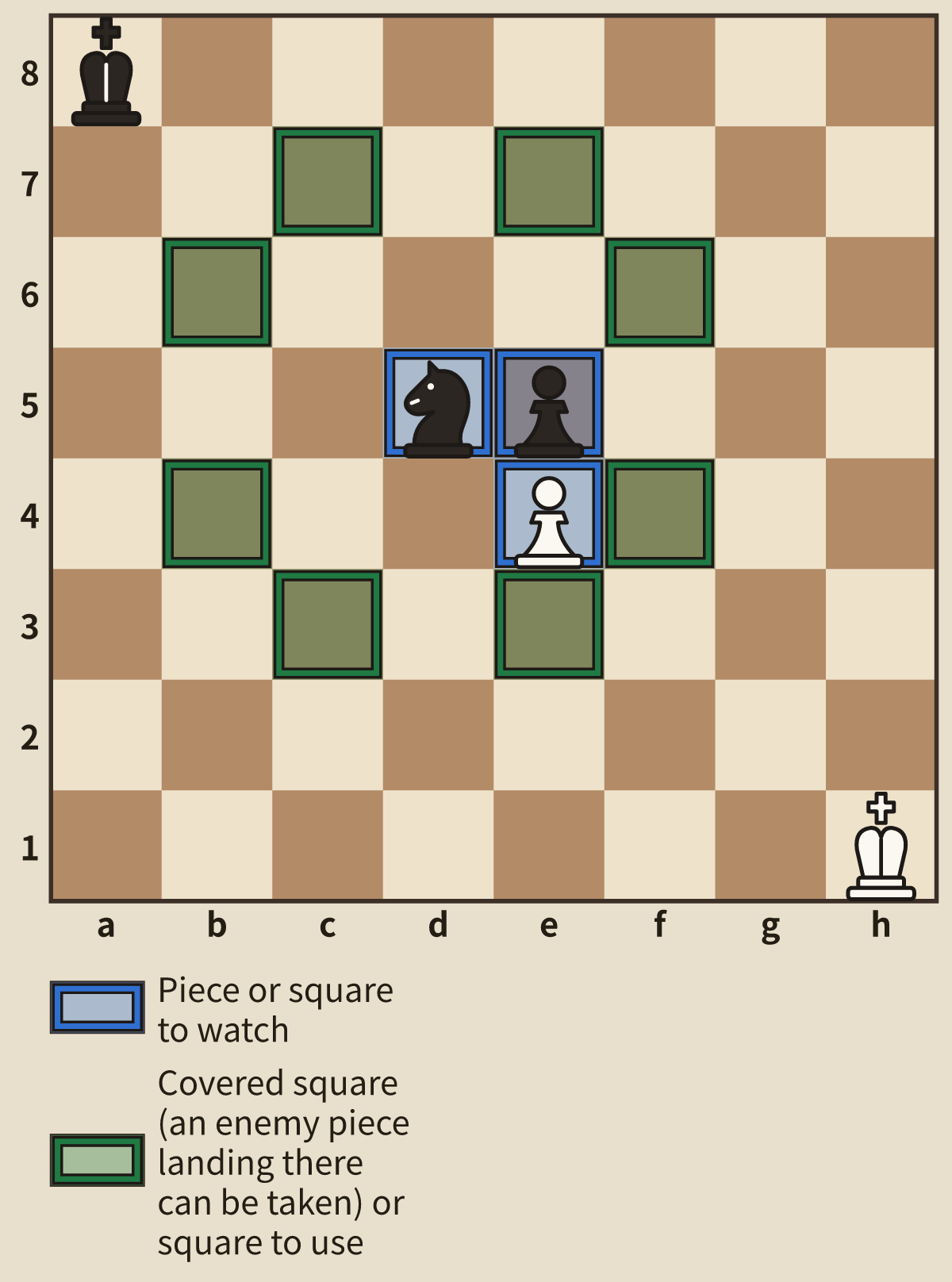
Figure 1 as text
White: King h1, Pawn e4
Black: King a8, Knight d5, Pawn e5
To move: White
Highlighted squares: e4 (watch), e5 (watch), d5 (watch), b4 (covered), b6 (covered), c3 (covered), c7 (covered), e3 (covered), e7 (covered), f4 (covered), f6 (covered)
FEN: k7/8/8/3np3/4P3/8/8/7K w - - 0 1
In this diagram, focus on the White pawn on e4. A pawn basically advances forward 1 square at a time, moving forward if e5 right in front of it is empty. However, if there is an opponent's piece or a friendly piece directly ahead, it cannot move forward, nor can it jump over the opponent's piece.
The pawn's most distinctive rule is that it moves diagonally forward 1 square only when capturing an opponent's piece. From the pawn on e4 in the diagram, a Black knight sits diagonally forward on d5. White can move the pawn to d5 to capture the Black knight. Meanwhile, the Black pawn on e5 directly opposite is straight ahead, so it cannot be captured, nor can the pawn advance past it.
Also, only for a pawn that has not moved once from its starting position on the 2nd rank (the 2nd rank for White, the 7th rank for Black), it can choose to move 1 square or 2 squares forward on its first move. Advancing 2 squares in the opening allows it to quickly fight for control of the central squares.

Play in the app
Tactics you learn stick best when tested on the board. The AI thinks on your device, letting you play complete matches even with no signal.


Promotion and Special Rules
Figure 2 as text
White: King h1, Pawn e7
Black: King e8
To move: White
Highlighted squares: e7 (watch), e8 (watch), d7 (covered), f7 (covered)
FEN: 4k3/4P3/8/8/8/8/8/7K w - - 0 1
In this diagram, the White pawn has advanced deep into enemy territory to e7. When a pawn reaches the opposite end of the board (e8 on the 8th rank for White, the 1st rank for Black), a special transformation called promotion occurs.
A pawn reaching the 8th rank must promote to a queen, rook, bishop, or knight. It cannot become a king or remain a pawn, and in most cases, the queen is chosen for its immense power. Even if your original queen is still on the board, it can be promoted as a 2nd queen. This rule of transforming a pawn into a powerful piece serves as a major objective in the endgame.
Another special move is en passant. Only on the turn immediately after an enemy pawn moves 2 squares forward from its starting position to land right beside your pawn, you may capture it diagonally forward (on the square it passed through), as if it had only moved 1 square. Since the right is lost once you make another move, be careful not to overlook it in games.
Values of the 6 Pieces and the Pawn's Role

There are 6 types of pieces in chess, and standard piece values (points) are assigned to each based on their mobility and effectiveness. They are widely used as criteria when deciding piece exchanges.
| Piece | Value | Movement |
|---|---|---|
| Pawn | 1 point | Moves 1 square forward; captures 1 square diagonally forward. May move 2 squares on its first move. |
| Knight | 3 points | Jumps in an L-shape. Can leap over other pieces. |
| Bishop | 3 points | Moves diagonally any number of open squares. |
| Rook | 5 points | Moves any number of squares in straight horizontal or vertical lines. |
| Queen | 9 points | Powerful piece moving any distance along files, ranks, and diagonals. |
| King | Infinite (loss ends game) | Moves 1 square in any direction. If it is lost, you lose the game. |
While 1 point is the lowest value, 8 pawns working together form a resilient wall that shields your camp. Seizing control of the center with pawns is fundamental to securing the initiative.
If you want to get a solid feel for moving and capturing, trying out pawn advances against beginner AI in the mobile chess app Chess: Emperor Napoleon is very helpful. Move pieces on the board right at your fingertips and experience the depth chess pawns unlock.
Frequently asked questions
Can a pawn move backward?
No, a pawn cannot move backward. It only moves forward and can never return to an earlier square.
Can I promote to a piece other than the queen?
Yes, you can choose a rook, bishop, or knight instead. Situations occasionally call for underpromoting to a knight.
Can a pawn capture an enemy piece directly in front?
No, pawns only capture diagonally forward. A piece directly in front blocks the pawn's forward progress.
Put the rules into practice in a match against the computer!
Lead 50 historical engagements as Napoleon in Chess: Emperor Napoleon. Free to play with optional in-app purchases.
Play Now