Learning King Moves and Roles in Chess: Basic Guide
Published

For those just starting out in chess, learning how pieces move on the chessboard and the main objective of the game is an essential first step. The king is the center of your forces; if cornered without any escape, the game is decided.
A chessboard consists of 8 rows and 8 columns, making 64 squares in total. Both White and Black command 16 pieces, with White to move first, followed by alternating single turns. Let us look at the king's fundamental movement and how your other pieces support it.
How the King Moves and Piece Value on the Board
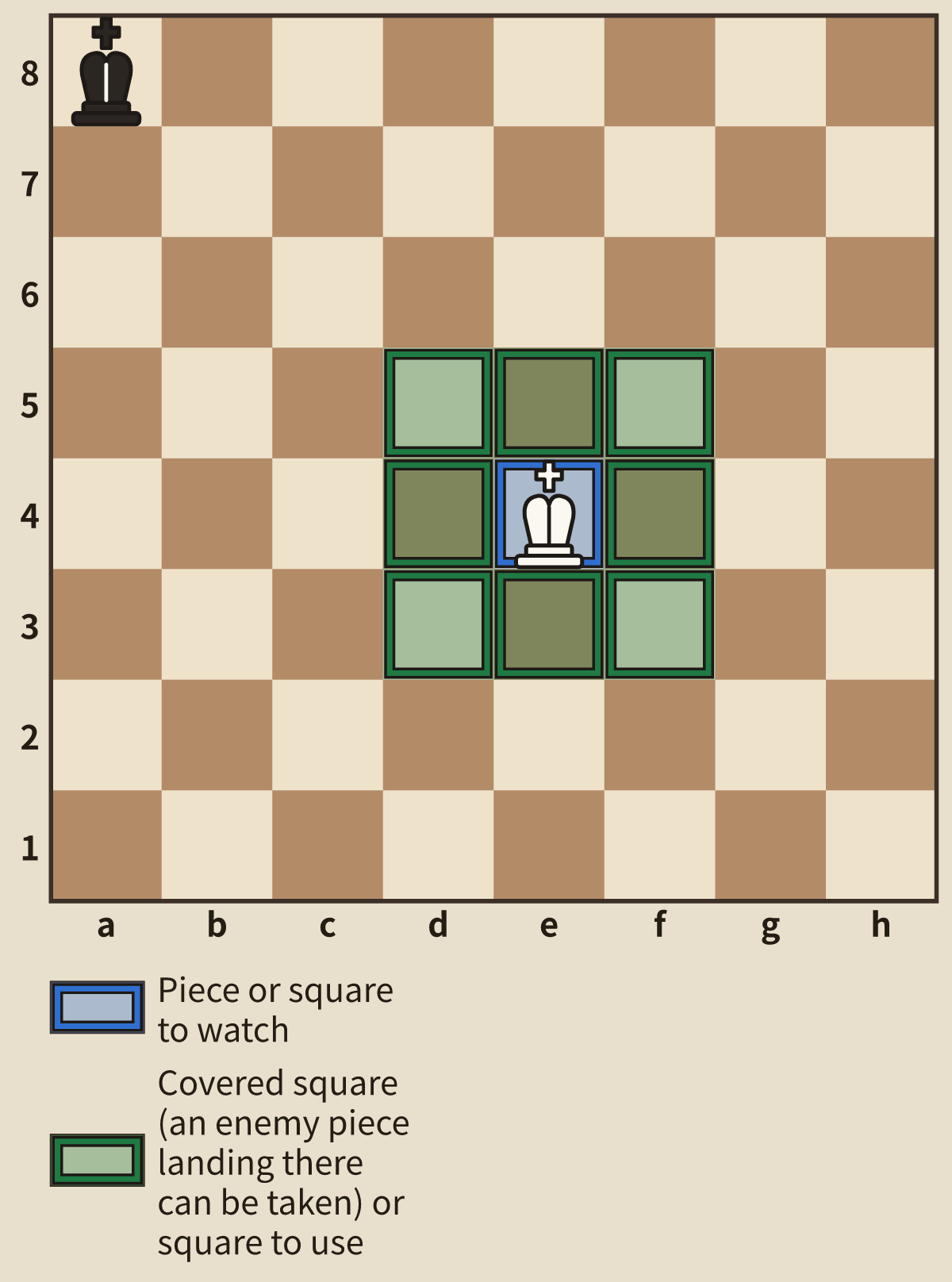
Figure 1 as text
White: King e4
Black: King a8
To move: White
Highlighted squares: e4 (watch), d3 (covered), d4 (covered), d5 (covered), e3 (covered), e5 (covered), f3 (covered), f4 (covered), f5 (covered)
FEN: k7/8/8/8/4K3/8/8/8 w - - 0 1
This diagram shows the moving range of a white king on e4. The king can step 1 square into any of the 8 adjacent squares: d5, e5, f5, d4, f4, d3, e3, and f3. It can move in all directions—vertical, horizontal, and diagonal—always at a pace of 1 square. Moving into a square under enemy control is not permitted.
Chess features 6 distinct types of pieces, including the king. Each piece possesses different mobility, corresponding to an established standard piece value. Because losing the king ends the contest, it has no point value, but knowing the other values helps when weighing an exchange.
| Piece | Count (per side) | Movement Traits | Standard Value |
|---|---|---|---|
| Pawn | 8 | Forward 1 square (2 squares on first move); captures diagonally forward | 1 point |
| Knight | 2 | Leaps in an L-shape; can jump over other pieces | 3 points |
| Bishop | 2 | Moves any number of squares diagonally | 3 points |
| Rook | 2 | Moves any number of squares vertically and horizontally | 5 points |
| Queen | 1 | Moves any number of squares vertically, horizontally, and diagonally | 9 points |
| King | 1 | Moves 1 square in all 8 surrounding directions | Infinite (determines win/loss) |
During the opening and middlegame, you guard high-value pieces like the queen and rook while setting up footholds to breach the opposing defenses.

Play in the app
A tactic learned is best mastered by playing it out on the board. The AI thinks directly on your device, allowing you to finish games anywhere without a connection.


Castling: A Special Move for King Safety
Figure 2 as text
White: King e1, Rook h1
Black: King a8
To move: White
Highlighted squares: e1 (watch), h1 (watch), d1 (covered), d2 (covered), e2 (covered), f1 (covered), f2 (covered), g1 (covered), h2 (covered), h3 (covered), h4 (covered), h5 (covered), h6 (covered), h7 (covered), h8 (covered)
FEN: k7/8/8/8/8/8/8/4K2R w - - 0 1
This diagram illustrates kingside castling with a white king on e1 and a white rook on h1. Castling is the only special rule that moves the king and rook simultaneously in 1 turn. It shifts the vulnerable central king toward the side of the board and mobilizes the corner rook into the center.
When kingside castling is played, the king on e1 travels 2 squares to g1, and the rook on h1 leaps across to f1. Several requirements must be met to execute this maneuver.
- Neither piece has moved: Both the king and the participating rook must not have moved previously.
- Empty intervening squares: The squares between the king and the rook must be completely clear.
- No enemy attack: Castling cannot be done while in check, nor through or into any square under opponent control.
Castling early in the opening to safeguard the king is a fundamental plan for steering into a secure struggle.
Endgame Climax: Distinguishing Mate from Draw

As pieces thin out in the late game, the outcome draws near. Threatening the opposing king directly is known as check. When placed in check, a player must address it on the next turn through one of 3 remedies:
- Move the king to a safe square out of attack.
- Capture the attacking enemy piece with your own piece.
- Interpose a friendly piece between the attacker and your king.
If none of these 3 remedies can avert the attack, the state is checkmate, instantly ending the encounter.
Beginners must also watch out for a draw by stalemate. If the side whose turn it is faces no check yet holds no legal move anywhere on the board, the game immediately ends in a draw. An attacking player can easily deny the opponent moves by mistake, throwing away an earned win.
To practice these principles and hone endgame technique, test your skills in the smartphone app "Chess: Emperor Napoleon". Build your instincts for shielding your king and breaking through opponent defenses.
Frequently asked questions
Can the king capture enemy pieces on its own?
Yes, if an enemy piece rests on an accessible square, the king can capture it. However, it cannot move onto a square that leaves it in check under enemy control.
How many times can castling be used in 1 game?
White and Black may each use it only 1 time per game. Once castling is played or the king is moved, castling can no longer be performed in that game.
What is the exact difference between checkmate and stalemate?
The distinction lies in whether there is a check. Being checked with no escape results in checkmate and decides the winner; lacking any legal move without check results in stalemate and a draw.
Put the rules into practice in a match against the computer!
Take command as Emperor Napoleon across 50 battles in the chess app Chess: Emperor Napoleon. Free to play with optional in-app purchases.
Play Now