How the Chess Knight Moves: Basics and Strong Play in Real Games
Published

For those starting chess, understanding how pieces move and what they are worth is the first step. The knight has a unique movement unlike any other piece, which often puzzles beginners at first.
Chess is a game played on an 8x8 board of 64 squares, where White and Black each use 16 pieces to corner the opponent's king. Every piece has its own range and role. Let's first review the basic values and roles of all 6 types of pieces.
Conclusion: The knight moves in an L-shape by going 2 squares straight and then 1 square at a right angle, and it is the only piece that can jump over other pieces. Placing it in the center gives it more squares to reach, making it excellent at forking 2 pieces at once.
In this article, squares are referred to by name. A square's name combines a file letter from a to h (from left to right) and a rank number from 1 to 8 (from White's side forward). A game score is the record of a game. In notation, the knight is written with the letter N, followed by its destination square.
The symbols in the diagrams are used as follows:
- Blue outline: Piece or square of interest
- Green square: Controlled square (where an opponent piece can be captured) or square to be used
- Red square: Targeted or endangered square
- Green arrow: Key move (the piece movement highlighted in each diagram)
Basics of the 6 Piece Types and Their Point Values
There are 6 types of chess pieces: pawn, knight, bishop, rook, queen, and king. In a match, pieces are often captured or traded, so knowing their relative values in points helps in making sound decisions.
| Piece | Point Value | Movement |
|---|---|---|
| Pawn | 1 point | Moves 1 square forward, captures diagonally forward. Can move 2 squares on its first move only. |
| Knight | 3 points | Moves in an L-shape (2 squares straight, 1 square at a right angle). Can jump over other pieces. |
| Bishop | 3 points | Moves diagonally any number of squares as long as no piece is in the way. |
| Rook | 5 points | Moves horizontally and vertically any number of squares as long as no piece is in the way. |
| Queen | 9 points | Moves horizontally, vertically, or diagonally any number of squares as long as no piece is in the way. |
| King | Priceless | Moves 1 square in any direction. If it is checkmated you lose, so it has no point value. |
Point values are not absolute and vary depending on the position, but they serve as a vital guide to avoid losing material during exchanges. For example, giving up a 3-point knight or bishop for a 1-point pawn leaves you 2 points behind, resulting in a loss. Start by making a habit of evaluating positions with these points in mind.

Play in the app
Tactics are best mastered by trying them on the board. The AI thinks entirely on the device, allowing you to play full games even without an internet connection.


The Knight's Unique Leap and Movement
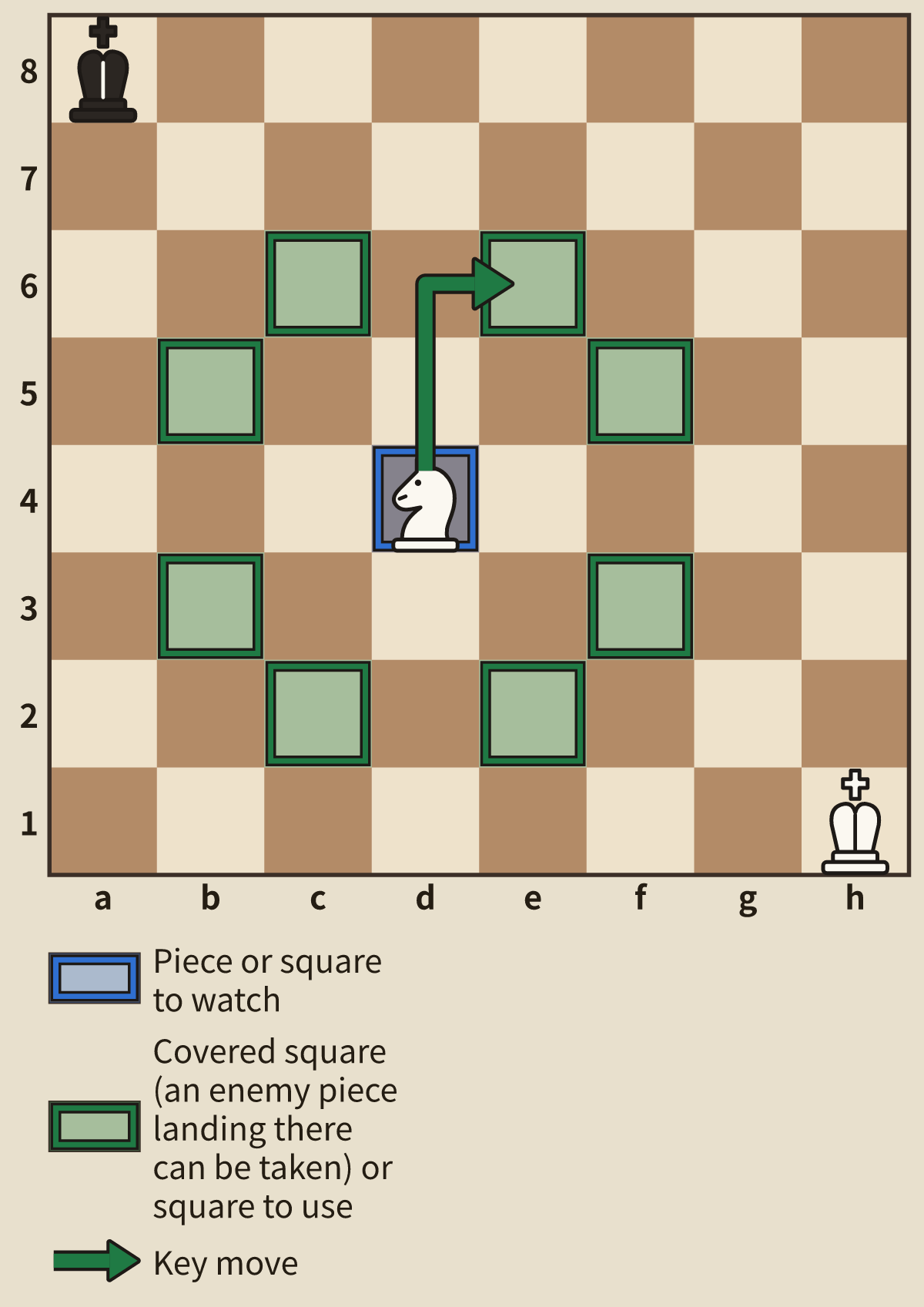
Figure 1 as text
White: King h1, Knight d4
Black: King a8
To move: White
Highlighted squares: d4 (watch), b3 (covered), b5 (covered), c2 (covered), c6 (covered), e2 (covered), e6 (covered), f3 (covered), f5 (covered)
Arrows: d4→e6 (key move)
FEN: k7/8/8/8/3N4/8/8/7K w - - 0 1
In this diagram, White's knight is on d4 in the center of the board, with its legal moves shown in green. d4 is on the 4th file from the left and the 4th rank from White's side. The knight moves in an L-shape: 2 squares straight and then 1 square at a right angle (the green arrow illustrates one move, from d4 to e6). From d4, it can move to c6, e6, b5, f5, b3, f3, c2, or e2. The knight controls all 8 squares. The kings on a8 and h1 are placed only to make the position valid and do not move here.
The knight's defining trait is its ability to leap over other pieces. Long-range pieces such as rooks, bishops, and queens are blocked whenever friendly or opposing pieces stand in their path. The knight, however, ignores all obstacles and lands directly on its target square.
Another essential property is that the knight always changes the color of its square on every move, alternating between light and dark (brown in our diagrams). A knight standing on a dark square like d4 is guaranteed to land on a light square on its next move. Keeping this color shift in mind makes it easier to predict where an enemy knight can jump next.
Practical Knight Forks in Real Play

Figure 2 as text
White: King h1, Knight b5
Black: King e8, Rook a8
To move: White
Highlighted squares: c7 (watch), e8 (under attack), a8 (under attack)
Arrows: b5→c7 (key move)
FEN: r3k3/8/8/1N6/8/8/8/7K w - - 0 1
In this diagram, White's knight is on b5. As shown by the green arrow, jumping to c7 (recorded as Nc7+, where + denotes check) puts Black's king on e8 in check while simultaneously attacking Black's rook on a8. The 2 red squares are the targeted squares. A move where 1 piece attacks 2 or more opponent pieces at once is called a fork. White's king on h1 is placed only to make the position valid and does not move here.
A knight fork is notoriously difficult to defend against. The 3 ways to escape check are moving the king, blocking the attack with another piece, or capturing the checking piece. Because a knight leaps over intermediate squares, blocking is impossible. In this diagram, Black has no piece that can capture the knight, leaving running with the king as the only option, after which White can take the rook on a8 on the next move.
To maximize the knight's power, placing it near the center of the board is vital. On the edge, a knight can only jump to 2 to 4 squares, but near the center it controls up to 8. Even in closed positions where pawns are locked, the leaping knight shines as a primary attacker.
- Place it where it cannot be kicked: Put it on a square where enemy pawns cannot drive it away, keeping it active for longer.
- Aim for forks: Attack the king and another piece simultaneously to win valuable material.
- Use its jumping ability: Advance smoothly even in congested positions, regardless of pieces in front of it.
To practice these mechanics and piece coordination at your own pace, trying out moves against the AI in the mobile app Chess: Emperor Napoleon is an effective way to improve. Playing real games will naturally teach you how to catch opponents off guard with the knight.
Frequently asked questions
Which piece is more valuable, the knight or the bishop?
Both have a base value of 3 points. However, when many pieces remain and the board is crowded, the knight's jumping ability gives it an advantage. Once pieces are cleared and the board opens up, the long-range bishop tends to gain the upper hand.
Can a knight move on the first turn?
Yes, it can. Because the knight can jump over the pawns in front of it, it can leap out past the pawn line right from the first move.
Is there a trick to spotting where a knight can move quickly?
The trick is to look for squares of the opposite color from the one it is currently on. A knight always alternates between light and dark squares with every move, so focusing on the opposite color makes its destinations easier to spot.
How does the knight move in chess?
It moves in an L-shape: 2 squares straight and then 1 square at a right angle. It can leap over any piece in its way.
Where should the knight be developed in the opening?
Standard development places it on the 3rd rank from your side, on either the 3rd or 6th file from the left. Both squares control central squares, providing far more mobility than placing it on the rim.
Put the rules into practice in a match against the computer!
Play as Emperor Napoleon across 50 historic battles in Chess: Emperor Napoleon. Free to play with optional in-app purchases.
Play Now