Chess Bishop Basics and Piece Values
Published

When learning the game, understanding how each piece moves is the first step. The bishop glides diagonally across the chessboard with unlimited range, unleashing powerful threats from the middlegame to the endgame. Let us examine the fundamental traits of this piece on the alternating light and dark squares.
Mastering the Diagonals: Bishop Moves and Traits
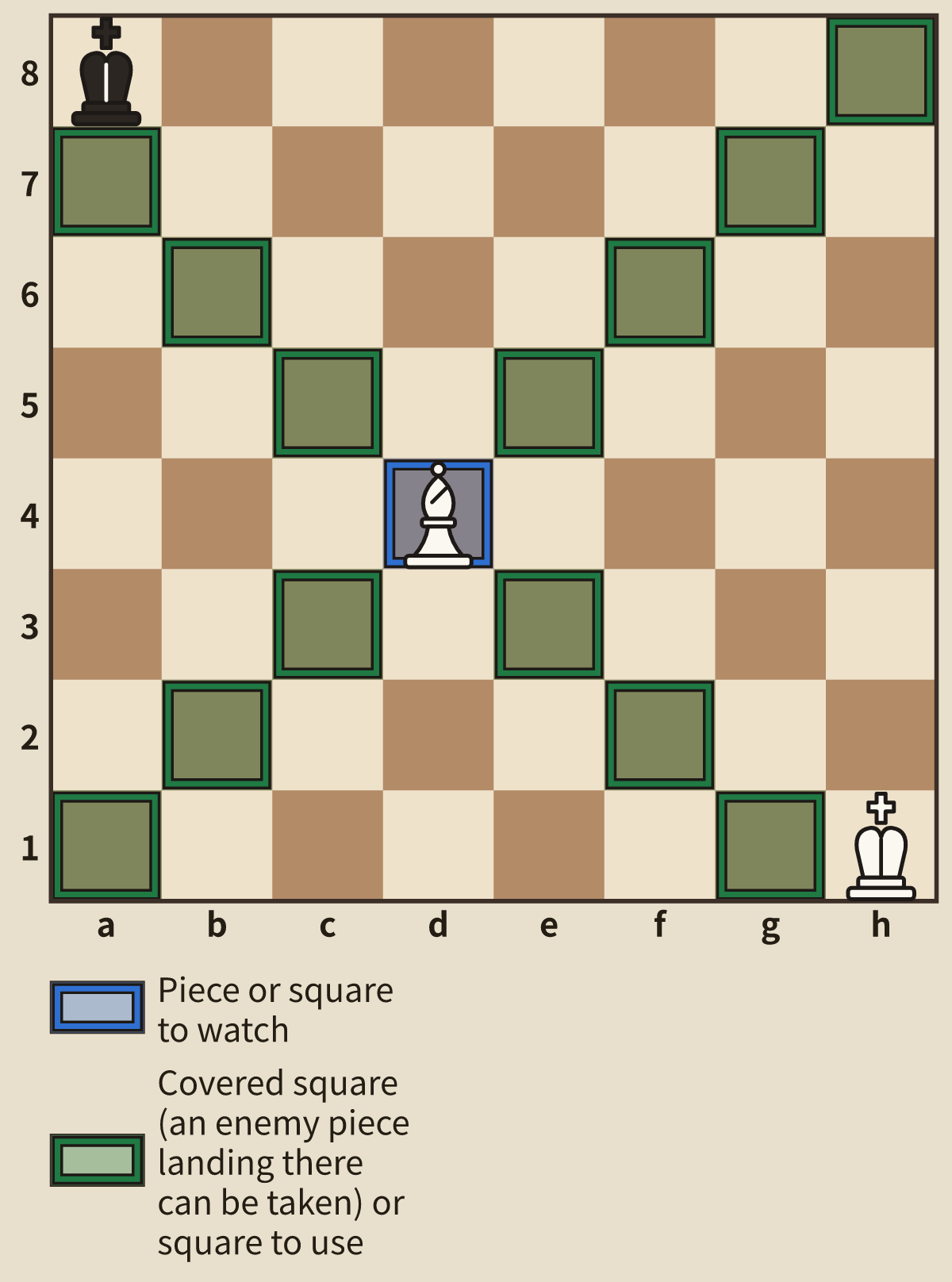
Figure 1 as text
White: King h1, Bishop d4
Black: King a8
To move: White
Highlighted squares: d4 (watch), a1 (covered), a7 (covered), b2 (covered), b6 (covered), c3 (covered), c5 (covered), e3 (covered), e5 (covered), f2 (covered), f6 (covered), g1 (covered), g7 (covered), h8 (covered)
FEN: k7/8/8/8/3B4/8/8/7K w - - 0 1
In this diagram, White's bishop stands on the central square d4. It can move any number of squares diagonally as long as friendly or enemy pieces do not block its path. From d4, its control extends diagonally in all directions, along diagonals like a1 to h8 and a7 to g1. With an open diagonal, it can strike deep into enemy lines.
The bishop's defining trait is that it remains on its starting square color for the entire game. A bishop placed on a light square is called a light-squared bishop, while one on a dark square is a dark-squared bishop. Because a bishop commands squares of only that color, it cannot attack pieces on opposite-colored squares on its own. Coordinating 2 bishops so they cover each other's blind spots is essential to building an advantage. From the opening through the middlegame, keeping both bishops cooperating to control broad swathes of the board is ideal.
The 6 Pieces: Moves and Relative Values
Chess features 6 distinct piece types, each with its own move set and relative point value. Knowing these values guides smart choices during an exchange.
| Piece | Movement | Value |
|---|---|---|
| Pawn | Moves 1 square forward (2 on first move). Captures 1 square diagonally forward | 1 point |
| Knight | Leaps in an L-shape. Can jump over other pieces | 3 points |
| Bishop | Moves diagonally any number of squares. Cannot change square color | 3 points |
| Rook | Moves horizontally or vertically any number of squares | 5 points |
| Queen | Powerful piece moving any number of squares along ranks, files, or diagonals | 9 points |
| King | Moves 1 square in any direction. If lost, the game ends (most crucial) | Infinite |
Both knight and bishop share a piece value of 3 points. Knights can jump over other pieces, making them formidable in closed positions crowded with pawns. Bishops excel in open positions with clear diagonals. Choosing which piece to keep depends on the position.
Play in the app
Practicing tactics on the board cements your skills. The AI calculates entirely on your device, allowing you to play anywhere without an internet connection.


Bishop Tactics: The Power of the Pin
Figure 2 as text
White: King h1, Bishop g5
Black: King a8
To move: White
Highlighted squares: g5 (watch), c1 (covered), d2 (covered), d8 (covered), e3 (covered), e7 (covered), f4 (covered), f6 (covered), h4 (covered), h6 (covered)
FEN: k7/8/8/6B1/8/8/8/7K w - - 0 1
Suppose White places a bishop on g5, targeting Black's knight on f6. If the black queen stands behind that knight, Black cannot safely move the knight away from f6. Restricting an enemy piece because a higher-value piece sits behind it is a tactic called a pin.
Bishops can apply pins from afar, exerting heavy pressure on the opponent's camp. Targeting the line of the king or queen early on hinders enemy plans. In Chess: Emperor Napoleon, you can test long-range bishop setups against the AI at your own pace.
Avoid placing your own pawns where they hinder your bishop. With a light-squared bishop, placing pawns on dark squares keeps diagonal lines open. Be sure friendly pieces do not block your own bishop.
Endgame Caution: Avoiding Unintended Draws

When many pieces are traded off, the game enters the endgame. Kings step up to support advancing pawns. Reaching the last rank (rank 8 for White, rank 1 for Black) triggers promotion to a queen, rook, bishop, or knight—most often the queen.
Even with an overwhelming lead, beware of stalemate when trapping the king. Stalemate happens when the player on turn is not in check but has zero legal moves. When this occurs, the game ends immediately in a draw regardless of material.
- Checkmate: The king is in check with no legal move to escape or block (a decisive win).
- Stalemate: The king is not in check, but the player has no legal move (results in a draw).
- Draw by insufficient material: Neither side has enough pieces to deliver checkmate, such as a lone king and 1 bishop.
Cornering the enemy king with a bishop can easily cause stalemate if all escape squares are covered without giving check. Always leave at least 1 legal square open or keep delivering checks toward checkmate.
Frequently asked questions
How many squares can a bishop move?
It can move diagonally across any number of open squares. It cannot leap over pieces; it stops before friendly pieces or captures an enemy piece on its square.
Which piece is stronger: bishop or knight?
Both have a base piece value of 3 points. Bishops favor open positions with long diagonals, while knights excel in closed positions crowded with pawns.
Can a bishop alone checkmate the enemy king?
A king and 1 bishop alone cannot force checkmate due to insufficient material, ending in a draw. Delivering mate requires 2 bishops or support from other pieces.
Put the rules into practice in a match against the computer!
Step into the boots of Napoleon across 50 historic battles in Chess: Emperor Napoleon. Free to start, with optional in-app purchases.
Play Now