How the Queen Moves in Chess and Practical Tips to Use It
Published

When sitting before a chessboard, one piece stands out as uniquely striking and dependable. The chess queen can move freely along ranks, files, and diagonals, serving as a primary force with mobility that easily surpasses every other piece.
Because the queen is so powerful, misusing her early in the game can turn her into an easy target for your opponent. Let us first master how the queen moves and how to project control across the squares.
How the Queen Moves and Mobility in 8 Directions
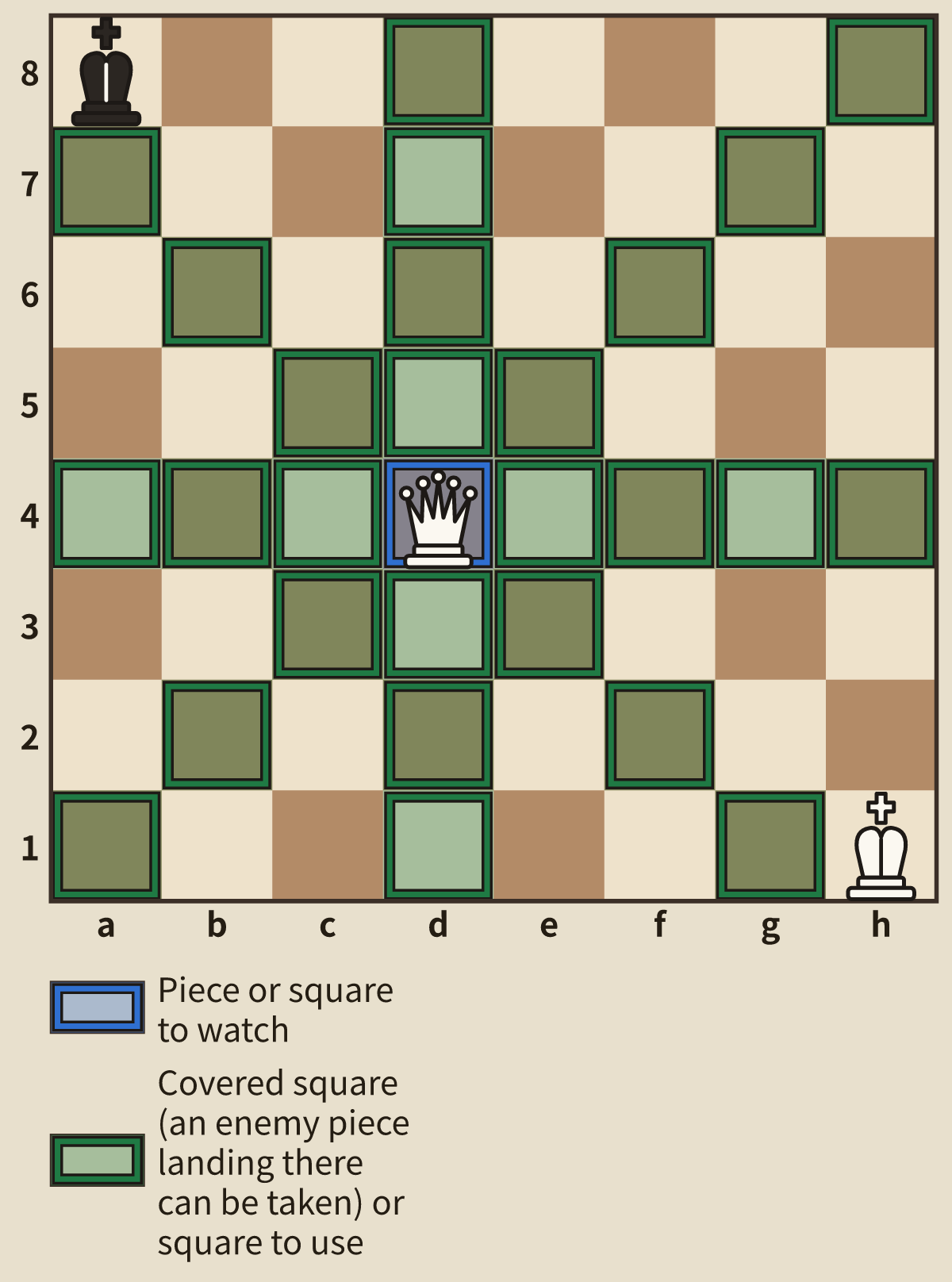
Figure 1 as text
White: King h1, Queen d4
Black: King a8
To move: White
Highlighted squares: d4 (watch), a1 (covered), a4 (covered), a7 (covered), b2 (covered), b4 (covered), b6 (covered), c3 (covered), c4 (covered), c5 (covered), d1 (covered), d2 (covered), d3 (covered), d5 (covered), d6 (covered), d7 (covered), d8 (covered), e3 (covered), e4 (covered), e5 (covered), f2 (covered), f4 (covered), f6 (covered), g1 (covered), g4 (covered), g7 (covered), h4 (covered), h8 (covered)
FEN: k7/8/8/8/3Q4/8/8/7K w - - 0 1
This diagram illustrates the piece's control from d4 in the center. Combining the rook's rank-and-file movement with the bishop's diagonal reach, it can move any number of empty squares in a straight line across all 8 directions—forward, backward, sideways, and diagonally—as long as no friendly or opposing piece blocks the path.
If an enemy piece stands on the destination square, the queen captures it and stops there. She cannot enter a square occupied by a friendly piece or jump over other pieces. She combines swift long-range attacking power with reliable defense for her own camp.
In the starting position, the white queen begins on the light square d1 and the black piece begins on the dark square d8. Remember: "white on white, black on black"—she starts on her own color. Pawns block her path initially, but pushing center pawns opens lines quickly.

Play in the app
Trying tactics directly on the board is the best way to master them. The AI calculates entirely on your device, allowing full offline matches anywhere.


Value of the 6 Pieces and Queen Importance
Chess features 6 types of pieces: king, queen, rook, bishop, knight, and pawn. Each piece has an assigned relative score (piece value) based on its power, serving as a key benchmark for evaluating the game.
| Piece | Count (per side) | Relative Value | Movement |
|---|---|---|---|
| Pawn | 8 | 1 point | Moves 1 square forward, captures diagonally forward |
| Knight | 2 | 3 points | Moves in an L-shape and can jump over pieces |
| Bishop | 2 | 3 points | Moves any number of squares diagonally |
| Rook | 2 | 5 points | Moves along ranks and files any number of squares |
| Queen | 1 | 9 points | Moves in 8 directions any number of open squares |
| King | 1 | Infinite (determines victory or defeat) | Moves 1 square in any direction |
With a pawn valued at 1 point, the queen is worth 9 points. That exceeds the combined strength of 1 rook (5 points) and 1 minor piece like a bishop or knight (3 points).
Capturing an opponent's queen safely brings you close to victory, while carelessly losing your own often leads to defeat. Because of her high value, you must stay alert against threats from less valuable enemy pieces.
Beginner Tips and Checkmate Patterns

Figure 2 as text
White: King e1, Queen f7, Rook a1 h1, Bishop c4 c1, Knight b1 g1, Pawn e4 a2 b2 c2 d2 f2 g2 h2
Black: King e8, Queen d8, Rook a8 h8, Bishop c8 f8, Knight c6 f6, Pawn a7 b7 c7 d7 g7 h7 e5
To move: Black
Highlighted squares: f7 (watch), c4 (covered), e8 (covered)
FEN: r1bqkb1r/pppp1Qpp/2n2n2/4p3/2B1P3/8/PPPP1PPP/RNB1K1NR b KQkq - 0 4
In this position, the white queen strikes at f7, attacking the black king on e8 to deliver checkmate.
Because the queen is defended by the White bishop on c4, the Black king cannot capture it. Furthermore, every square of escape for the king is cut off. Working together with other pieces to target weaknesses in the opposing camp like this is key to harnessing the queen's decisive power.
The most common pitfall for beginners in real games is launching a solo queen charge into the front lines early in the opening. Bringing it out too soon simply because it is powerful lets the opponent threaten it while naturally developing their knights and pawns. While the queen scurries around to escape, only the opponent finishes their development, frequently seizing the initiative.
Before moving your queen in the opening, always check whether an opponent's knight or pawn can chase it on the next turn, and make sure it has adequate defense so you can recapture if it is taken.
A sound way to play is to control the center with pawns, develop your knights and bishops first, and wait until the middlegame before fully unleashing your queen. If you want to refine how you move pieces and coordinate them, playing casually on your smartphone with Chess: Emperor Napoleon is an excellent way to practice.
- Coordinate with other pieces: Advance close to the enemy king backed by a bishop or rook.
- Aim for forks: Attack 2 pieces simultaneously using control across ranks, files, and diagonals.
- Make it work in the endgame: On a board with fewer pieces, use its wide control to corner the opposing king.
As games transition into the endgame and pieces leave the board, the queen's wide control shines even brighter. In addition, when an advancing pawn reaches the enemy camp's last rank (the 8th rank for White, or the 1st rank for Black), it can achieve promotion into another piece, and the most powerful piece, the queen, is chosen in almost every case. Understanding the queen's role and guiding it carefully is a surefire step toward victory.
You can play games against the computer in the app all the way to the end without an internet connection, allowing you to test what you have learned about the queen on the board right away.
Frequently asked questions
Can the queen jump over other pieces?
No, she cannot jump. While she moves any number of squares in 8 directions, pieces block her path. If she hits an enemy piece, she captures it on that square and ends her move.
Can a pawn promote to a queen if one is already on the board?
Yes. Promotion does not depend on pieces currently on the board. Having 2 or more queens at the same time is entirely within the rules.
Is it bad to move the queen early in the opening?
Generally, yes. Early outings expose her to enemy knights and pawns, wasting tempos as she flees while accelerating the opponent's development.
How does the queen move in chess?
She moves any number of open squares along ranks, files, and diagonals. In the starting position, she begins on her own color: White on d1, Black on d8.
What is the point value of the queen?
She is worth 9 points, with a pawn as 1 point. That is higher than 1 rook and 1 minor piece (bishop or knight) combined.
Put the rules into practice in a match against the computer!
Play as Emperor Napoleon across 50 campaigns in Chess: Emperor Napoleon. Free to play with optional in-app purchases.
Play Now