Basic Guide to Chessboard Setup and Starting Positions
Published Updated
Conclusion: Remember 3 points, and you will set up without mistakes. First, place the board so the bottom-right corner square is a light square from your perspective. Second, on your back rank, place rooks, knights, and bishops working inward from the edges. Place the queen on a light square if white, or on a dark square (brown on our board) if black, with the king on the remaining square. Third, place 8 pawns on the rank directly in front.

When starting Chess, the first skill to learn is how to set up the pieces. When the pieces are placed on the correct squares, each piece can unleash its true power. For the movement and role of each piece, see our detailed guide in Chess Piece Moves and Basic Values.
A chessboard consists of a total of 64 squares, 8 squares each across and down. Both White and Black have a total of 16 pieces: 1 king, 1 queen, 2 rooks, 2 bishops, 2 knights, and 8 pawns, and the game begins with White to move first.
The blue frame in the diagram highlights the piece to focus on.
In this article, we refer to squares by name. The vertical files are labeled letters a through h from left to right from White's perspective, while the horizontal ranks are numbered 1 through 8 from White's side to the opposite side, combining the letter and number.
Board Orientation and Setting the 1st Rank
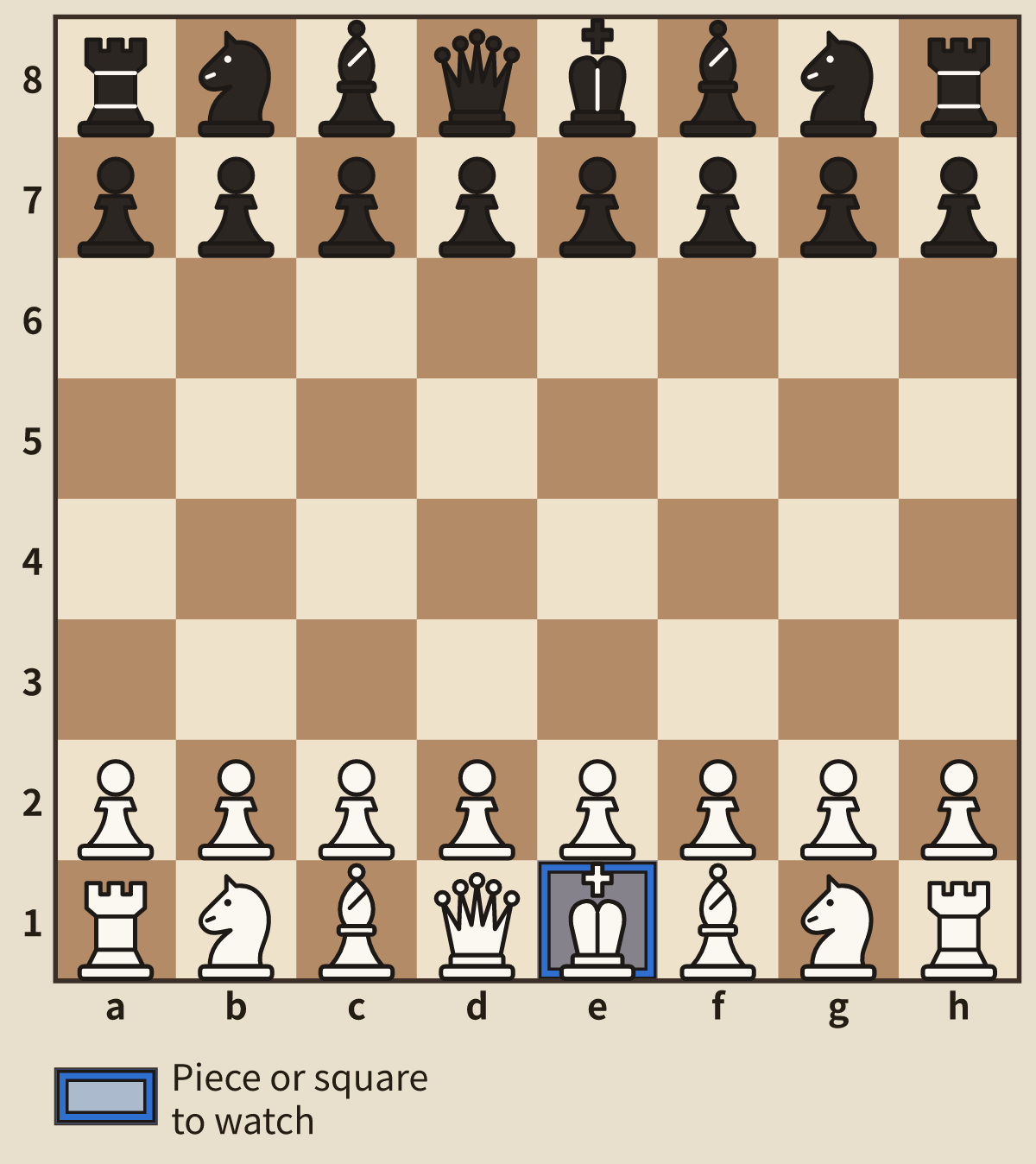
Figure 1 as text
White: King e1, Queen d1, Rook a1 h1, Bishop c1 f1, Knight b1 g1, Pawn a2 b2 c2 d2 e2 f2 g2 h2
Black: King e8, Queen d8, Rook a8 h8, Bishop c8 f8, Knight b8 g8, Pawn a7 b7 c7 d7 e7 f7 g7 h7
To move: White
Highlighted squares: e1 (watch)
FEN: rnbqkbnr/pppppppp/8/8/8/8/PPPPPPPP/RNBQKBNR w KQkq - 0 1
This diagram shows the starting position from White's perspective. h1 is the 8th file from the left and the 1st rank from your side. When placing the board, make sure the bottom-right corner square is a light square from your perspective. From White's perspective, bottom-right is h1, and from Black's, it is a8; both are light squares. In the diagram, bottom-right h1 and d1, where White's queen stands, are both light squares. The blue frame marks the king on e1 next to d1. Once oriented, place rooks on both ends of the 1st rank.
Place castle-shaped rooks on the outer edges at a1 and h1. Place horse-headed knights inward on b1 and g1, and diagonally moving bishops further inward on c1 and f1. In the central 2 squares, place the white queen on d1 and the white king on e1. Remember: queen goes on her own color.
- Bottom-right is light: The bottom-right corner from White (h1) and from Black (a8) is a light square.
- Queen on her color: White's queen sits on light square d1, and Black's queen sits on dark square d8.
- Pawns on the rank ahead: Line up pawns on all 8 squares of the 2nd rank for White and the 7th rank for Black.
Having a set order keeps you from getting confused. First, place rook, knight, and bishop symmetrically working inward from the outer ends of the 1st rank, then fill the remaining 2 center squares with the queen and king. Placing all pieces on the 1st rank before lining up 8 pawns on the 2nd rank makes it easier to spot piece count mistakes.
The key tip to remember is that the king and queen stand side by side on the middle 2 squares of the 1st rank, flanked symmetrically on both sides by the same pieces.

Black's Perspective and Facing White
Figure 2 as text
White: King e1, Queen d1, Rook a1 h1, Bishop c1 f1, Knight b1 g1, Pawn a2 b2 c2 d2 e2 f2 g2 h2
Black: King e8, Queen d8, Rook a8 h8, Bishop c8 f8, Knight b8 g8, Pawn a7 b7 c7 d7 e7 f7 g7 h7
To move: White
Highlighted squares: e8 (watch)
FEN: rnbqkbnr/pppppppp/8/8/8/8/PPPPPPPP/RNBQKBNR w KQkq - 0 1
Seen from Black's perspective, the board is rotated 180 degrees from White's view. Thus, the letters below the diagram run h, g, f... a from left to right, and rank numbers run 1, 2... 8 from top to bottom. The bottom-right square a8 is a light square.
Black's king stands on e8 and the queen on d8, directly facing White's king and queen on the same files. Black's queen stands on dark square d8, and the blue frame highlights the king next to it on e8.
Because the board is reversed, reading this diagram from left to right makes the king appear first and the queen second. In terms of square names, the queen is on the d-file and the king is on the e-file, exactly like White. The remaining pieces also go from the outside inward: rook, knight, bishop, with knights on b8 and g8, bishops on c8 and f8, and pawns filling all 8 squares of the 7th rank.
Play in the app
Tactics stick best when you try them on the board. Your computer opponent thinks right on your device, so you can finish every game against it, anywhere.


Scan with your phone to open the store
3 Checks After Setup
- Board orientation: Is the bottom-right corner square a light square from your perspective?
- King and queen: Does White's queen stand on a light square, Black's queen on a dark square, and the king right beside her (the 2 center squares of the 1st rank)?
- Knight and bishop: Is the knight right inside the rook, with the bishop inside the knight?
Common mistakes include rotating the chessboard 90 degrees or swapping the positions of the king and queen. If the orientation is wrong, the rule "queen on her own color" will not match, so check the bottom-right corner and the color of the queen's square after setup. Each piece's moves are explained in detail in Chess Piece Moves and Basic Values.
Once you know how to set up the board, learning terms like checkmate and castling makes playing even more enjoyable. Their meanings and origins are gathered in Meanings and Origins of Chess Terms.
How each piece moves is covered in "How Many Squares Can a Bishop Move?" and "How the Queen Moves and Where It Starts", while the full rules, including how to win or lose, are introduced in "Chess Rules and How to Play".
Sharpen Your Skills with Mobile Matches

After learning the rules and setup, playing practical matches is the quickest path to improvement. A smartphone app makes it easy to practice in your spare time.
In Chess: Emperor Napoleon, you can enjoy offline matches against an AI that runs entirely on your device. With 6 difficulty levels from beginner to master, players of all skill levels can find a balanced opponent.
In matches against the AI, you can take back a move up to 3 times per game, allowing you to review and learn if you accidentally move a piece to a dangerous square. After the game, use the feature to review the game score move by move along with the post-game AI review to steadily build your chess skill.
Frequently asked questions
How can I remember where kings and queens go?
Place the queen on a square matching her color: White's queen on a light square, Black's queen on a dark square, with the king on the square next to her.
How do I check if the chessboard orientation is correct?
Check whether the bottom-right corner square is a light square from your perspective. Whether viewed from White or Black, the bottom-right corner is always a light square.
Which goes on the outside, knight or bishop?
The knight sits just inside the rook, and the bishop sits inside the knight. On your back rank, arrange them symmetrically from the ends inward: rook, knight, bishop.
Which rank do pawns occupy?
Place them across all 8 squares of the 2nd rank from your perspective. That is the 2nd rank for White and the 7th rank for Black.
How many pieces start the game, and what goes in the 4 corners?
White and Black each have 16 pieces, for a total of 32. A rook is placed in each of the 4 corners of the board.
Put the rules into practice in a match against the computer!
Step into Napoleon's boots across 50 historic battles in Chess: Emperor Napoleon. Free to play with optional in-app purchases.
Play Now
Scan with your phone to open the store