History and Board Tactics: Chess and Napoleon
Published

Numerous anecdotes surround the emperor who shook Western history and his relationship with the board game. Napoleon is said to have played chess both on military campaigns and in exile, with many tales passed down, though their historical accuracy varies. Let us reflect on the atmosphere of that era while mastering the fundamentals of the game we play today.
The Board Battlefield and the Roles of the Pieces
Chess is an intellectual contest fought on a board of 64 squares across 8 files and ranks. Divided into White and Black sides, each commands 16 pieces to advance the battle. It is always White to move first, alternating moves one by one. Examining the types and traits of each side's pieces reveals a structure resembling an actual army.
| Piece Name | Quantity | Characteristics |
|---|---|---|
| king | 1 | The most vital piece, moving 1 square in any direction |
| queen | 1 | A powerful force moving any distance straight or diagonally |
| rook | 2 | Moves straight horizontally or vertically without limit |
| bishop | 2 | Moves diagonally across any number of squares |
| knight | 2 | Jumps over other pieces to 8 possible squares |
| pawn | 8 | Moves forward only and gains promotion on the last rank |
The ultimate objective of the battle is checkmate, cornering the opponent's king with no escape. Rules such as castling, a defensive maneuver moving the king and rook at once, and en passant, capturing a pawn as it passes, add profound tactical depth.
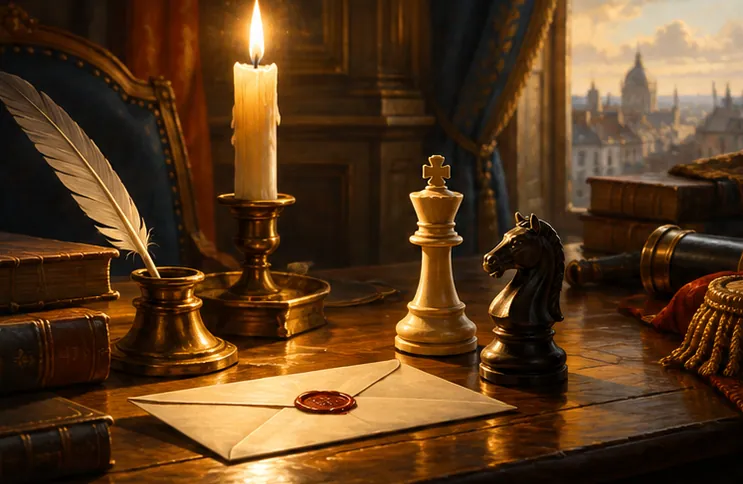
Legends and Anecdotes of the Emperor
Napoleon is said to have frequented the Café de la Régence in Paris since his days as a young officer, engrossed in games on the board. While he swept Europe as a military genius, contemporary memoirs and later historical studies often describe him as enthusiastic but weak, and not skilled in the opening, suggesting his playing ability was modest. This assessment forms an intriguing contrast with his reputation for bold troop maneuvers.
- Games during campaigns: He reportedly gathered around the board inside his tent against his staff officers and aides to refresh his mind.
- Match against the automaton: Around 1809 at Schönbrunn Palace in Vienna, he reportedly played against the automaton known as The Turk and deliberately made illegal moves. However, the date, location, and details differ among sources, and the surviving game score is viewed with strong skepticism.
- Final years in exile: On Saint Helena, he is also said to have played chess with his entourage. There is a tale of exquisite Chinese carved pieces sent as a gift, but accounts dispute whether he actually received them: some say Governor Hudson Lowe demanded the removal of the carved imperial crowns and 'N' initials, while others claim the set was never delivered and returned to the sender.
His human nature, wavering between cold calculation and audacious maneuvers, may well have been vividly reflected in his play on the board.
Play in the app
Learned tactics take root when tested on the board. The AI thinks entirely on your device, letting you play complete matches even without a network signal.


Tactics Deciding Victory and the Rules of a Draw
From opening theory and middlegame skirmishes to endgame technique, chess possesses an elaborate body of knowledge. Controlling the center squares and maximizing piece activity are the first steps toward victory. However, no matter how favorable your position, failing to understand the specific draw rules of chess can cause a win to slip away.
- Stalemate: A state where the player whose turn it is is not in check, yet has no legal move available.
- 50-move rule: A draw that can be claimed when 50 moves each (100 plies in total) pass without a pawn move or a piece capture.
- Threefold repetition: A draw that can be claimed when the exact same position and rights (turn, castling, and en passant rights) appear 3 times during the game.
- Insufficient material: A state where neither side can possibly deliver checkmate with the remaining pieces on the board, regardless of the sequence of moves.
A common mistake beginners make in the endgame is over-restricting the opponent's king while having an advantage, resulting in a stalemate. Even when ahead in material, one must remain alert and mindful of the opponent king's legal squares.
Reliving Historical Campaigns on Your Smartphone

If you wish to improve while savoring the atmosphere of historic campaigns, the app Chess: Emperor Napoleon for iPhone and Android is an ideal choice. Faithfully adhering to standard chess rules, it offers comfortable portrait-mode operation. Furthermore, the app automatically concludes the game as a draw upon reaching the 50-move rule or threefold repetition without requiring a claim.
Matches against the AI can be played to the end even without an internet connection. To learn how to progress through campaigns or make use of takeback and post-game reviews when facing tough CPU opponents, see our guide on conquering campaign mode when you cannot beat the chess CPU. Why not refine your tactical vision while immersing yourself in this historical journey?
Frequently asked questions
Was Napoleon actually strong at chess?
Historical records suggest he was not particularly strong. Contemporary memoirs and later research describe him as enthusiastic but weak and lacking in opening skill, and many attributed game scores are considered dubious.
Can I play against the AI offline without a mobile signal?
Yes, matches against the AI can be played to completion without internet connectivity. The AI computes everything directly on your device, allowing you to enjoy games offline.
Is an internet connection required to view post-game AI reviews?
Yes, an internet connection is required for AI reviews. The feature that provides written analysis highlighting key points of the match operates online.
What is the difference between checkmate and stalemate?
The difference is whether the king is under check. Being in check with no escape results in a win by checkmate, whereas having no legal move while not in check results in a draw by stalemate.
Play in the app
Take on 50 battles as Napoleon in the chess app Chess: Emperor Napoleon. Free to play with optional in-app purchases.